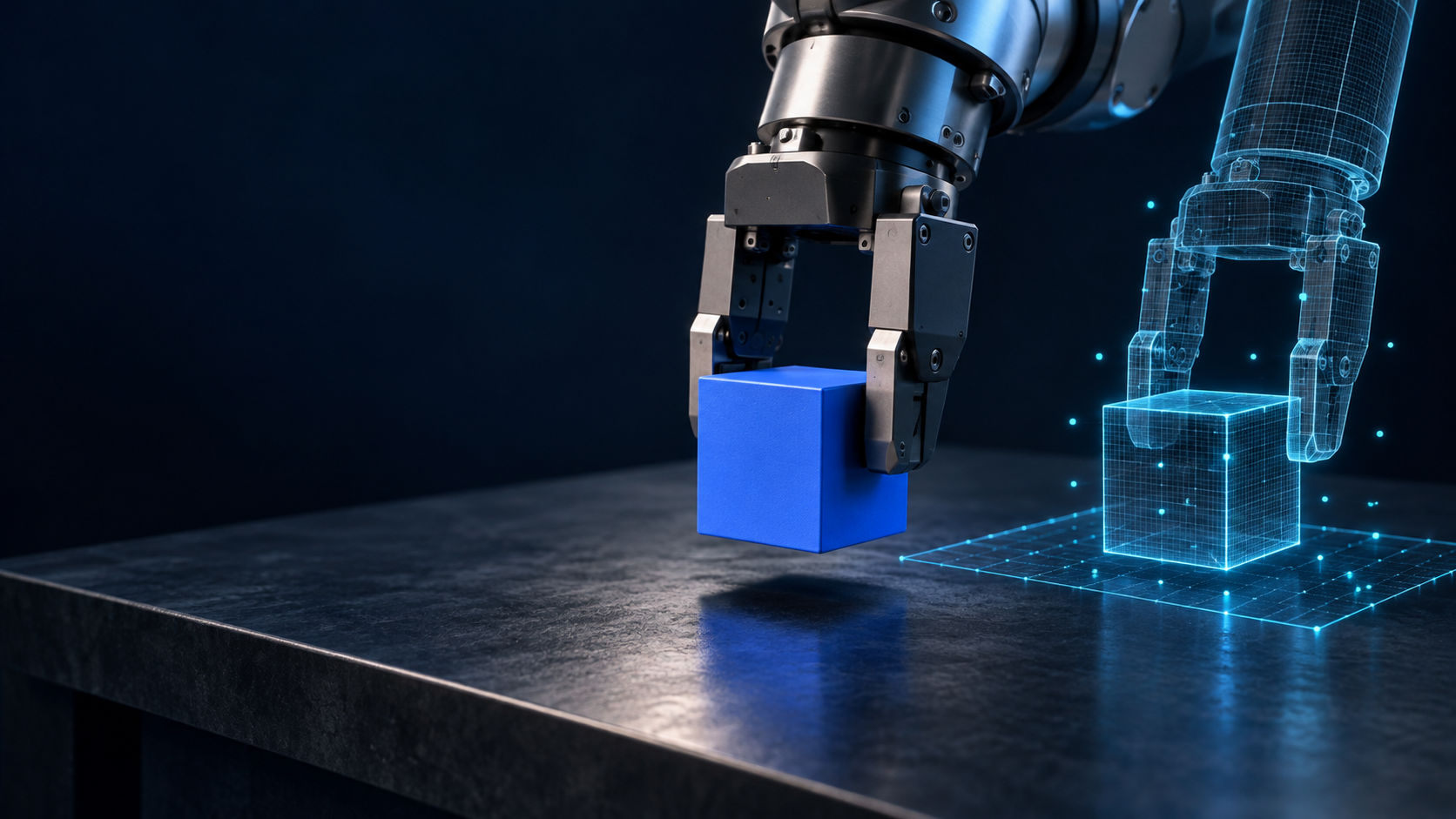
AI-generated editorial illustration · Conceptual scene, not a product capture.
Black Forest Labs describes FLUX 3 Action as a model that predicts future frames and actions together, with task-specific fine-tuning examples spanning robot arms, small games and a simulated drone. The useful detail is the shared observation-and-action loop: record what a controller sees and does, adapt the policy, then test it in changed conditions. Its game results are a narrow demonstration, with the published comparison using one seed and a sixty-second run.
Why it’s useful. The accompanying recipes offer a concrete starting point for reusable game and simulation testbeds. Varying layouts and perturbing runs can reveal recovery behavior that a clean demonstration misses.
What to keep in mind. These are the developer’s reported demonstrations and benchmark claims. LindiSims has not reproduced them. Game performance does not establish physical accuracy or reliable behavior on unfamiliar hardware; review the weight license separately.
AI-generated editorial illustration · Conceptual scene, not a product capture.
Hugging Face has added a discovery filter and framework tags for reinforcement-learning environments hosted as dataset repositories. Its first release focuses on task sets, while runtimes and verifier code remain in the repository or framework. That is a useful separation for anyone sharing a repeatable experiment: the task data, loading instructions and scoring rule can travel together without pretending every runner is interchangeable. The post also shows how to inspect rewards and verifier output before evaluating an agent.
Why it’s useful. Simulation and game-tool authors can borrow this packaging approach: version the inputs, document the run command and show what the reward measures. Reusable scenarios become easier to inspect and compare.
What to keep in mind. The announcement establishes discovery and loading conventions, not a universal physics simulator. Tags do not convert incompatible environments. A successful format or reward check does not establish factual correctness, model fidelity or real-world competence.
AI-generated editorial illustration · Conceptual scene, not a product capture.
ProjectSim’s September benchmarking overview argues that robot evaluations should identify what a policy needs to practise next, rather than compress every ability into one score. Its own first experiment investigates whether more faithful simulated assets and scenes bring policy performance closer to a physical setup. The practical point is to preserve the difficulty being tested: if a simulated insertion removes the contact problem that defeats a real robot, more successful virtual practice may teach the wrong lesson.
Why it’s useful. This is a useful lens for synthetic-data and scenario design. Track the failure condition, document geometry and physical properties, and compare targeted practice with an equal amount of general practice.
What to keep in mind. ProjectSim describes a research direction, not a demonstrated solution to the real-to-sim gap. This edition does not independently verify the benchmark results reviewed in its article or claim its planned experiment has succeeded.